| |
|
|
Lethe
/ Catastrophe Point #7 & #8
Standard Edition
(2CD invisible birds USA) 2010
|
| 
disc one - catastrophe point #7 - 50.50
sound materials recorded at arsenic: lausanne, switzerland
2004.10.21 - 11.28
disc two - catastrophe point #8 - 58.00
sound materials recorded at ex power station : edinburgh,
scotland
2006.10.23 - 10.28
all compositions by lethe
photos by kuwayama kiyoharu
sleeve design by invisible birds &
kuwayama kiyoharu
letterpress printing by ben owen at
middle press, brooklyn
liner notes by giancarlo toniutti
liner notes written and designed by giancarlo toniutti
printed by tarrl lightowler at suspiracle
press
invisible birds continues lethe's catastrophe point
series with a 2cd set which includes 2 recordings in
his
series, one recorded in switzerland in 2004 and the
other recorded in scotland in 2006.
lethe's series take place in abandoned industrial sites,
using drones, chains, an occasional instrument, objects
found in the space, but most importantly the resonant
qualities of the space.
the wire magazine explained this series "the music
sounds like it's taking place in a vast, pitch black
aircraft
hangar of the soul".
yannick dauby said ""these are kiyoharu's
obsessive abstractions dealing with physical substance
and volume".
the packaging for this release was done in collaboration
with kiyoharu kuwayama and letterpress printer ben owen
with the hope of achieving something that reflects the
beauty and intensity of the work.
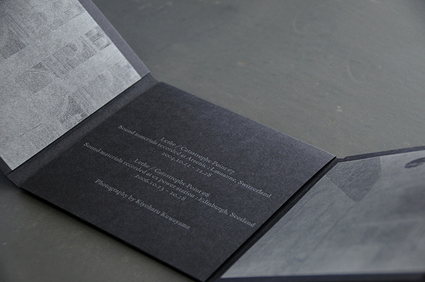
inside
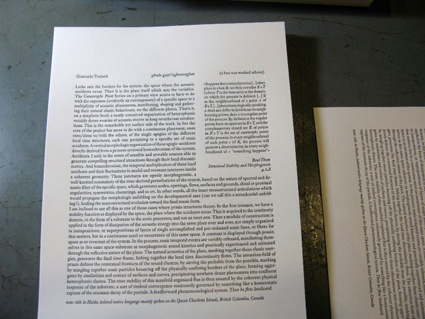
liner notes by giancarlo toniutti
http://invisiblebirds.org/
|
Review
LETHE
- CATASTROPHE POINT #7 & #8 (2CD by Invisible Birds)
Kuwayama Kiyoharu is the man behind Lethe. Under his
own name he works within the field of improvised music,
playing cello and electronics, in a duo called Kuwayama-Kijima
and as Lethe he creates music that deals with large
spaces with lots of natural reverberation, such as abandoned
warehouses, shinto temples, mausoleums and factories.
These works are called 'Catastrophe Point' and on this
double CD we find two of them. One (from 2004) was recorded
at Arsenic in Lausanne, Switzerland and the other at
an ex-power station in Edinburgh, Scotland, in 2006.
Inside such spaces, Kuwayama goes about to record the
empty space, picking up large reverberations with the
tiniest of sound information. Found metal is being scraped,
hit and dragged across the floor. Now that may seem
like a 'heavy' thing, but if you listen to these pieces,
there is a great sense of 'emptiness' in these recordings.
It stays far away, like being removed far away from
the microphone(s). I suspect he picks up his 'action'
with various microphones and then mixes these together
when it comes to releasing such works. Its hard to say
(and no doubt not really necessary) what this is, this
music of Lethe. Ambient? Perhaps, but not as we commonly
know it. Experimental? Surely. Action music, performance
art? No doubt that's true as well. You could wonder
why two discs. There are some interesting differences
between both works. The Scotland work is very sparse:
an empty space, a few sounds (in all three tracks).
The Switzerland piece has some sort of drone/alarm/buzz
going on, with lots of more activity. Towards the end
of the first part, the space around is removed and we
have a very clear picture of all sorts of acoustic activity
going on. In the second part a 'clear' piano pops up.
Maybe we have to keep the time frame in mind: in 2004
Lethe was perhaps more focussed on 'music' in a big
space, whereas in 2006 he was more interested in the
space itself. I am not entirely sure. Of the two 'Catastrophe
#7' would count as the more musical one, whereas 'Catastrophe
#8' would count as a piece of sound art. For either
drone lovers, improvised music fans and art goers, there
is something for everyone in this quite unique sound
world of Lethe.
(Vital Weekly 744 - frans de waard ) |
LETHE
- CATASTROPHE POINT #7 & #8 (2CD by Invisible Birds)
"Catastrophe Point 7 & 8" is a haunting,
eerier, original and subdued noisy mixture of: industrial
like field recordings, drones and the odd dab of minimalist
piano patterning and texturing. The Lethe project is
all the work of Japanese sound artists, subtle improviser
and uneasy mood-setter Kuwayama Kiyoharu. The project
has been in existence since the late 1990's, and it
certainly has avery distinctive, detailed yet unequal
feel to it's sonic unfold.
First off it's worth mentioning the rather stark, grim
yet oddly beautiful letter press & handmade 3 panel
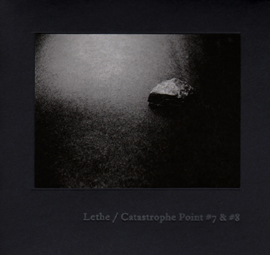
black card sleeve that the two CD's come in. The cover
features a rather cryptic picture of a single stone
half in light and half in darkness on the cover, inside
the sleeve are inversed or solarised pictures of the
inside of an abandoned factory. And in the middle pocket
of the sleeveis a single sheet of white A4 that offers
a rather pretentious and highbrow description of the
projects intentions( but don't let this put you off!).
This two disc set offers up two lengthy twenty plus
minute tracks on the first disc, and three tracks on
the second disc which fall between just over the thirteen
and twenty minute mark a piece. Each disc is also themed
around one site where field records are made/created
by the environment around Kiyoharu. The first disc features
the two tracks of Catastrophe Point 7, and was recorded
in a contemporary theatre space rather grimly called
Arsenic in Lausanne, Switzerland. And the second disc
features the three tracks that make upCatastrophe
Point 7, and this was recorded in an abandoned power
station in Scotland.
Each of the five pieces finds Kiyoharu creating a very
captivating and detailed, yet often subdued and spaced-out
sound map that takes in: echoed walking, pipe clunking
and dragging, all manner of sawing, banging and cluttering,
glass breaking and debis pulling apart, eerier and
harmonic drone textures, and the odd touch of doomy
or tinkling piano minimalism. Kiyoharu then arrangers
these elements into semi rhythmic or structured patterns
that sometimes flit with harmonic detail. All the tracks
are very loose yet precise making sure there's space
to hear and appreciate each element, yet it also keeps
some kind of structure and progression in place too.
I guess it's quite difficult to really define what this
is as it sits between being an: field recording album,
an natural ambient album, a subtle improvised album,
and a minimalist compositions album- and I guess that's
what makes this so rewarding, intriguing and original.
So if your after something that rather blurs the lines
between subtle noise, found sound and ambience this
is a must have item!
Multi-Genre Music Magazine / Roger Batty
Lethe - Catastrophe
Point #7 & #8 (Invisible Birds)
I greatly enjoyed my first exposure to the work of Lethe
(Kiyoharu Kumwyama) last year on Catastrophe Point #
5 (Intransitive). Here's a continuation (I guess I missed
#6), a two disc set recorded in 2004 (Lausanne) and
2006 (Edinburgh). The milieu remains the same: extremely
dark, forbidding, vast and post-industrial, shards of
sound echoing into the depths, metal bars dropped onto
hard floors, wails, alarms, groans, heavy steps...you
get the picture. Gradually drone-y electronics filter
in which take it out of the processed field recording
area, into more of a dark ambient one; I prefer the
former, though Lethe handles everything with deftness.
Piano enters, low and foreboding, reminding me a bit
of some of Asher's work, there's a crescendo of rushing
winds and clanging metal, all hugely dystopic and effective
as such but...at some point it blends together overmuch,
feels a bit too easy to achieve; the sense of exploring
the darkness I had in the earlier work isn't as apparent,
as if Lethe has mastered this particular realm and can
display his artistry at will.
The second, more recent recording is sparser and better
off for it, no less dark but with a more interesting
atmosphere, not merely oppressive but grimy and empty
as well. There's less "musical" input, more
noise. The final piece, just echoing thumps and bell
tones in the darkness, is quite impressive.
Still, it's a ton o' murk, probably a larger helping
than most can take in a sitting, but if you're so inclined,
Lethe doth provide.
BRIAN OLEWNICK
|
Lethe's
Catastrophe Point #7 & #8 is quite good as far as
abstract noise and sound collections go. This is probably
my favorite so far in the Catastrophe Point series.
Overall it's done in more of a drone style, with almost
constant lower and mid range frequencies, rather than
long periods of near silence bursting into sudden violent
cacophonies (as on other recordings). Kiyoharu Kuwayama
really stumbled onto some interesting sounds here, but
not in the sense of artists who go looking for what
relates to their own experiences or appeals to their
listeners. These are essentially spontaneous recordings
and more a result of the materials available to him
and the natural resonance of the recording spaces (#7
was recorded in a theater called Arsenic in Lausanne
Switzerland, #8 was recorded in a decommissioned power
plant in Edinburgh Scotland).
These recordings could be classified as "industrial"
in the truest sense of the word; before it was fashionable
to include edgy electronic sounds in music, there were
people strange (or crazy) enough to make grotesque,
aesthetically unappealing sounds with primitive analog
equipment and found objects, doing so as a reflection
of the decaying world around them and the inorganic
processes we depend upon, while passing it off as art.
Catastrophe Point is a more evolved version of this
same concept, seemingly intended to capture the decaying
structures of abandoned buildings and all the unique
sonic opportunities they provide.
Catastrophe Point #7 (the first disc) in particular
has some almost chilling moments, with pleasing but
alien sounds. There is also unexpected but surprisingly
appropriate classical piano recorded in the second untitled
track, one can only surmise there was a piano at hand
in the theater and it struck Kiyoharu's fancy to play
it.
The recordings don't seem to be released in any particular
order, in fact if I recall correctly, Kiyoharu simply
lets them remain in stasis, making occasional tweaks,
until he feels satisfied enough to release them. So
I can't say this is a progression from, say, Catastrophe
Point #5, but it's definitely a more satisfying experience,
I think mostly due to the types of frequencies captured
and the droning sounds which are easier for the ears
and mind to focus on, rather than artistic intent.
A rewarding listen if in a compatible mindset in a very
quiet room or wearing headphones. Now looking for more
of the Catastrophe Point series and other releases by
Invisible Birds (quality releases of abstract audio
and video).
historic bruno |
|
|
|