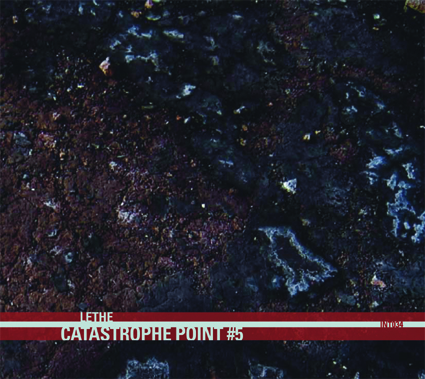
| Catastrophe Point #5
is the latest in Nagoya-based artist Kuwayama Kiyoharu’s
signature series of compositions that explore the charged,
mysterious atmosphere of disused industrial sites. Once
inspired by a space - in this case an abandoned warehouse
by a pier in Nagoya, Japan - Lethe searches for objects
in situ and uses them to perform a ritual of sonic alchemy,
or resurrection. He brings a dead space back to life,
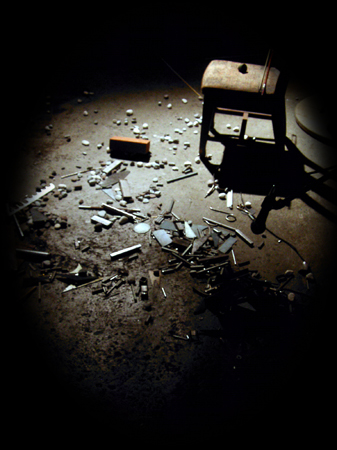
gives it a voice, and allows it to speak. Metal chains,
sheet metal, rocks, and factory debris are bowed, struck,
and dragged across the concrete floors of the massive
hall, reverberating and responding as Kuwayama and his
microphones scuttle across the desolate terrain. Over
the course of the album, the music stealthily shifts
from oceanic ambient haze to volatile, ominous malevolence.
Kiyoharu Kuwayama began
working with sound in the late 1980s, using half-scale
violin, cello, and found junk objects in the group Minotaure.
In 1999, he and violinist Rina Kijima formed the improvisational
acoustic duo Kuwayama-Kijima to bring their instruments
outdoors and perform in environments with unique acoustic
properties, notably underneath a highway overpass and
in a construction site. Between 1999 and 2003, Kuwayama
organized the five-day-long Lethe.Voice.Festival in
an unused grain warehouse.
Lethe is Kuwayama’s solo project, with the Catastrophe
Point series being his primary concern. Each piece is
the series is inspired by intensely resonant locations:
abandoned warehouses, Shinto temples, grain silos, and
underground shelters. His work is full of the empty
rattle of deserted industrial space, with carefully
constructed scrape and clang of objects found at each
location.
Lethe was last heard from on Intransitive with Tsurumai,
his stellar collaborative CD with Dutch noise legends
Kapotte Muziek. He has also appeared on albums with
bassist Matt Heyner (Malkuth, Cold Bleak Heat, No-Neck
Blues Band), Jonathan Coleclough, Hidekai Shimada (Agencement),
Carter Thornton (Enos Slaughter, Izititiz), Kiyoshi
Mizutani, Urabe Masayoshi, and Campbell Kneale (Birchville
Cat Motel).
Review
Lethe / Catastrophe Point #5
Lethe is Kuwayama Kiyharu and his instrument is an abandoned
grain warehouse. Within this space, he makes noise.
He does this by dragging large, heavy objects across
the dirty, irregular floor, by hurling other objects
against walls, battering sheets of metal, banging wood,
etc. Some eight minutes into the first track, a relatively
tonal, deep drone is sounded, only to fade, but giving
a glimmer of resonance. This tends to be the modus operandi:
the sounds of agitated, industrial detritus eventually
underpinned, in somewhat mournful fashion, by strings,
horns or other "real" instruments, as though
gazing with melancholy on catastrophic activity.
It's a compelling mix, in some ways reminiscent of the
music of Olivia Block who also has buttressed field
recordings with oddly traditional, chordal sounds. Lethe's
space, however, is both cavernous and claustrophobic,
not bucolic. When the brass enters the second of the
two pieces, amidst the clanking of chains and breaking
glass, the effect is anything but pastoral much more
anguished. One imagines some massive, endless, Beckettian
performance of La Monte Young's "Poem for Tables,
Chairs and Benches" with additional anarchic behavior
thrown in for good measure. A strong, dark effort, well
worth hearing.
- Brian Olewnick 2010-06-23
Lethe
/ Catastrophe Point #5
L’auscultation des espaces sonores est indubitablement
au coeur de la pratique de l’artiste japonais Lethe.
De´passant le strict point de vue environnementaliste,
il s’inclut lui-me^me dans les atmosphe`res industrielles
qu’il expose et, a` la manie`re d’un danseur de buto^,
va sobrement puiser l’e´clat enfoui au plus profond
de l’obscurite´.
Empruntant son pseudonyme a` la mythologie grecque,
Kiyoharu Kuwayama semble en effet ope´rer a` la frontie`re
des mondes, ceux du passe´ et du pre´sent, ressuscitant
des espaces abandonne´s et transfigurant les vestiges
d’une e`re industrielle qui s’en trouve largement
re´invente´e. Pourtant la musique de Lethe ne saurait
e^tre aussi paisible que le cours du fleuve des Enfers
et la me´moire d’une vie ante´rieure est ici loin
d’e^tre comple`tement efface´e. Bien au contraire,
un rituel occulte la convoque, la fait renai^tre de
la poussie`re, l’extirpe des murs pour la transformer
en une pre´sence sonore particulie`rement sombre et
suggestive. Le the´a^tre re´sonnant de cette ce´re´monie
est un entrepo^t de´saffecte´ du port de Nagoya. Pas
n’importe lequel : le nume´ro 20, un lieu que Kuwayama
connai^t bien pour y avoir organise´ un festival de
musique expe´rimentale de 1999 a` 2003. C’est d’ailleurs
juste apre`s sa dernie`re e´dition qu’a e´te´ enregistre´e
la matie`re premie`re de ce disque. Errant parmi les
de´combres, Lethe marche avec lenteur sur le sol granuleux,
se frotte au be´ton, marte`le les surfaces me´talliques,
re´anime des machines de´vore´es par la rouille et
en capte les moindres e´chos. Grincements lugubres,
ruminations du vent s’engouffrant dans les fissures,
humidite´ palpable dessinent un paysage tout en volumes
dans lequel Lethe, abandonnant souvent sa distance d’observateur,
intervient discre`tement en raclant des chai^nes, projetant
des tasseaux ou soufflant dans ce que l’on croit e^tre
une immense trompe, e´voquant autant l’activite´
portuaire environnante que les instruments invente´s
par Yoshi Wada.
Review : Jean-Claude Gevrey / scala tympani
Lethe
/ Catastrophe Point #5
Kuwayama Kiyoharu is better known as Lethe and his 'Catastrophe
Point #5' was recorded in an empty warehouse.
Inside Lethe plays metal chains, rusty metals and old
wheels that were found on the site, and using the resonant
space in which these objects lie around. The concrete
floor is an instrument too. To this Lethe adds his playing
of
a cello and some horn like sounds. Drone music in optima
forma, and one that is not heard a lot. Made by acoustic
instruments being played throughout the duration (I
am thinking here of Jos Smolder's recent CDR on drone
music,
which he thought was 'easy' to make - I guess Lethe
here proofs him wrong). Art music, that only vaguely
resembles the work of other scrap metal artists, such
as Organum, Z'EV or The New Blockaders. Lethe however
stretches out his playing in his own unique manner.
This is a truly gorgeous CD. (FdW)
VITAL WEEKLY 702
|